
UI UX Design

DEVELOPMENT

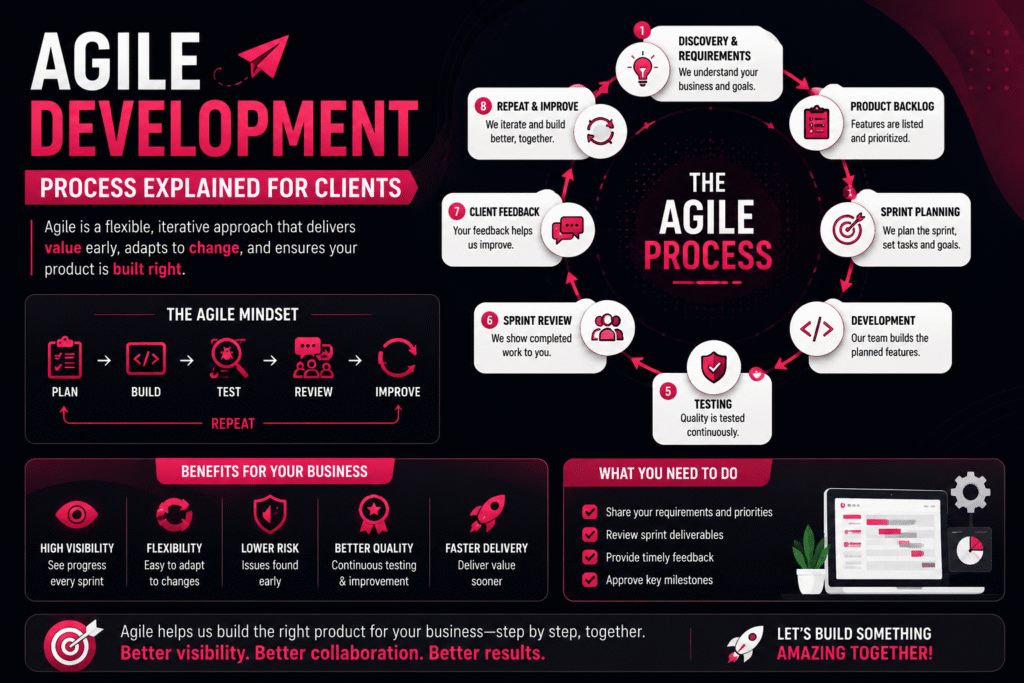
🚀 Agile Development Process Explained for Clients

🚀 How to Automate Your Business with a Custom App Agile Development Process Explained for Clients | Crawlers Technologies Intro What Is Agile The Process Backlog & Sprints Review & Feedback Launch Agile vs Traditional Client Role Myths & Benefits Client Guide · Software Development Agile DevelopmentExplained for Clients Stop waiting months to see progress. Agile breaks your project into small, reviewable stages so you’re always in control — with feedback at every step. 🔄 Sprints 💬 Feedback Loops 🧪 Continuous Testing 🚀 MVP Launch 📊 vs Traditional 🧠 Myths Busted Scroll to explore The Foundation What Is Agile Development? Agile is a flexible software development methodology focused on continuous delivery, real client feedback, and incremental improvement — instead of building everything in one go. Traditional vs Agile — The Core Difference ❌ Traditional Plan→ Build Everything→ Test→ Launch You see the result only at the end — months later. ✅ Agile Plan→ Build→ Test→ Review→ Improve→ Repeat You see working features every 1–4 weeks. Agile Core Principles 🔁 Continuous development 💬 Regular client feedback 🧪 Frequent testing 📈 Incremental improvements 🔓 Flexible requirements The Agile Cycle 🗺️Plan → 💻Build → 🧪Test → 👀Review → 💬Feedback → ⚡Improve ↺ How It Works The Agile Process — Step by Step An Agile project follows clear, repeatable stages that give you visibility and control throughout the entire build. Step 01 Discovery & Requirement Gathering The project begins by deeply understanding your business — goals, customers, features, competitors, budget, and timeline. The output is a clear product roadmap. Business Goals Target Customers Required Features Budget & Timeline Technical Requirements Step 02 Creating the Product Backlog A prioritized list of everything the application needs. The most important features are developed first, so you always get maximum value early. Step 03 Sprint Planning The project is divided into sprints — focused development cycles of 1–4 weeks. During planning, the team decides which features to build, who works on what, and what the sprint goal is. Building Blocks Backlog & Sprint Execution 📝 Example Product Backlog — E-Commerce App Features are listed and prioritised before development begins. High-priority items are built first. #01User registration #02Login & auth #03Product catalog #04Search #05Shopping cart #06Payment #07Order tracking #08Push notifications #09Admin dashboard 💻 Development — During Each Sprint Developers focus only on the features selected for that sprint — not the whole app. This keeps work focused and quality high. Frontend development Backend development API integration Database setup UI implementation 🧪 Testing Throughout Development Testing happens throughout every sprint — not only at the end. Finding bugs early makes them far cheaper and easier to fix. ✅ Functionality ⚡ Performance 🔒 Security 📱 Device compatibility 😊 User experience Client Involvement Sprint Review & Your Feedback At the end of every sprint, you see real working features — not a presentation or a status report. This is where Agile earns its value for clients. 👀 What You See After Each Sprint 1Login + Registration 2Product Catalog + Search 3Cart + Checkout 4Payments + Order Tracking 5Notifications + Admin Panel 💬 How Client Feedback Works After each sprint review, you share feedback. The team adds your input to the backlog and prioritises it for a future sprint. “The checkout process should have fewer steps — can we consolidate the address and payment into one screen?” This kind of real-time feedback ensures the final product is closely aligned with your actual business needs — not a guess made at the start of the project. Going Live Product Launch & Continuous Improvement 🚀 What the Launch Includes 📱 Google Play Store submission 🍎 Apple App Store submission 🖥️ Production deployment ⚙️ Server configuration 📊 Analytics setup 🔒 Security checks 💡 Agile doesn’t require waiting for every possible feature. You can launch an MVP and keep improving it based on real user feedback — saving budget and getting to market faster. 🔄 Continuous Improvement After Launch Agile development doesn’t end at launch. The same cycle continues to evolve and improve the product over time. Bug fixes New features Performance improvements Security updates User feedback integration Business requirement changes Head to Head Agile vs Traditional Development A clear breakdown of how these two approaches differ across every important factor. Factor Agile Traditional Development Style Incremental Sequential Client Feedback Frequent throughout Often limited during build Testing Continuous Concentrated at end Flexibility High Lower Progress Visibility High — see every sprint Lower — mostly at end Handling Changes Easier to accommodate Can be expensive late Product Delivery Incremental releases Usually one final delivery Risk Detected early May surface late Your Part What Does the Client Need to Do? Agile doesn’t mean managing developers daily. Your involvement is structured, lightweight, and high-impact. 📋 Provide Requirements Explain what your business needs at the start and as things evolve 🎯 Prioritize Features Decide which features are most important for the first release 👀 Review Sprint Work Check completed features and share honest, timely feedback ⚡ Make Quick Decisions Fast feedback prevents development delays and keeps momentum ✅ Approve Milestones Confirm the project is moving in the right direction at key stages 💰 Does Agile Increase Development Cost? Not necessarily — Agile can actually help you control costs. Because features are built incrementally, you can identify low-value items early and invest only in what matters. Instead of spending ₹10 lakh building every planned feature, you might launch an MVP first, learn from real users, and invest additional budget only in features that demonstrate real value. Clearing the Air Common Misconceptions About Agile Agile is often misunderstood. Here’s what it actually means — and what it doesn’t. “Agile means there is no plan.” Agile involves continuous planning rather than one rigid plan. The roadmap evolves — it never disappears. “Clients can change anything at any time.” Agile is flexible, but significant changes still affect scope, cost, and timeline — just less than in traditional development. “Agile means no deadlines.” Agile uses sprint goals, milestones, priorities, and delivery schedules. Accountability is built

DEVELOPMENT

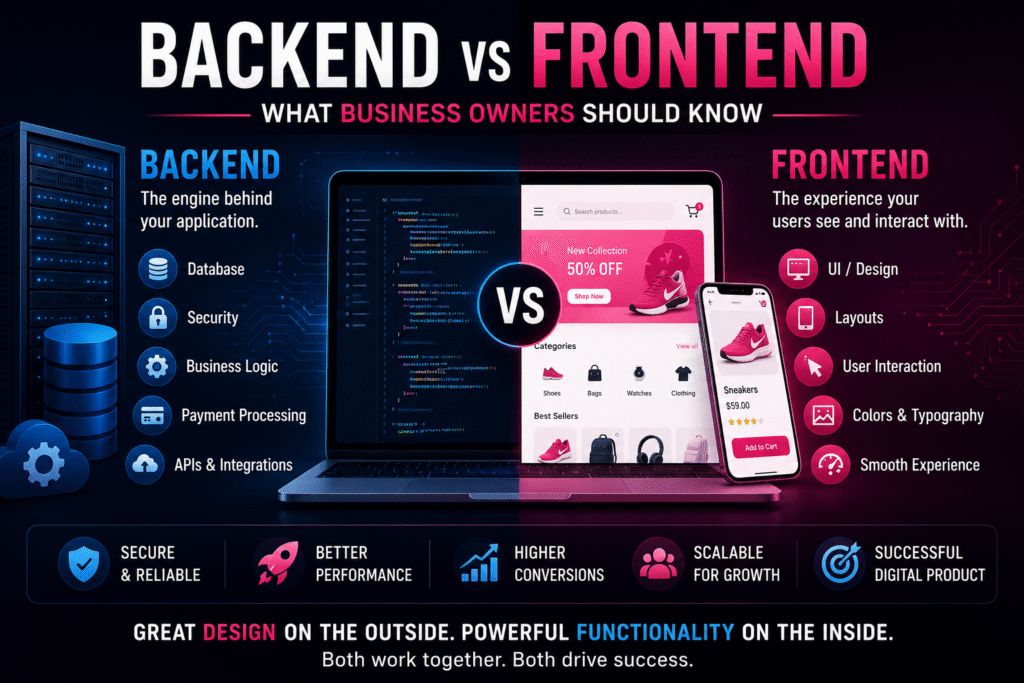
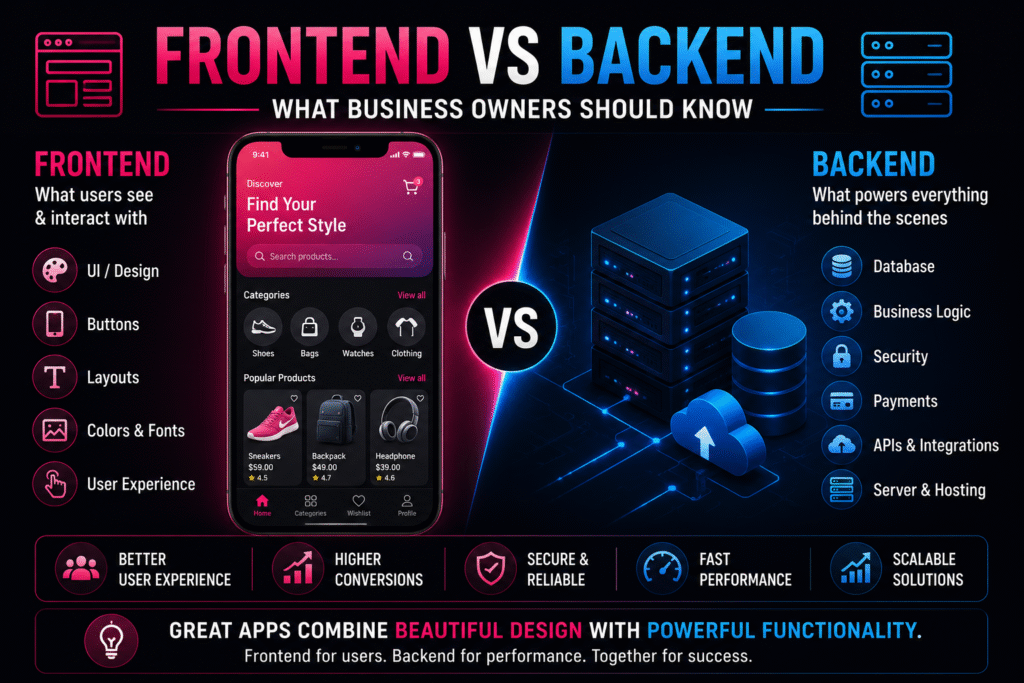
🖥️ Backend vs Frontend: What Business Owners Should Know

🚀 How to Automate Your Business with a Custom App Backend vs Frontend: What Business Owners Should Know Backend vs Frontend: What Business Owners Should Know Understanding both frontend and backend development helps business owners communicate better with developers, plan projects effectively, and build reliable digital products. 🌐 What Is Frontend Development? Frontend development is the part of your website or mobile app that customers directly see and interact with. It includes the home page, navigation, product pages, dashboards, forms, buttons, images, animations, and overall design. A well-crafted frontend creates a strong first impression and makes it easy for users to complete actions such as purchasing products or booking services. Business Value: Better user experience leads to higher engagement, trust, and conversions. UIUXCustomer Experience ⚙️ What Is Backend Development? The backend is the engine that powers your application behind the scenes. It manages databases, authentication, business logic, payment processing, APIs, notifications, and security. Without a backend, a website can display information but cannot process user actions or store data securely. Business Value: A strong backend ensures reliability, security, scalability, and smooth operations. APIDatabaseSecurity 📊 Backend vs Frontend Comparison Feature Frontend Backend Visible to Users Yes No Main Focus User Interface & Experience Business Logic & Data Handles Layouts, Forms, Navigation Server, Database, APIs Technologies React, Vue, Flutter Node.js, Laravel, Django 🔄 How They Work Together When a customer places an order, the frontend collects the information while the backend validates the payment, checks inventory, stores the order, and sends confirmation messages. Neither can function effectively without the other. A successful digital product balances a beautiful interface with a powerful technical foundation. 💡 Final Thoughts Frontend attracts users and delivers an engaging experience. Backend keeps your business running efficiently by processing data, securing information, and supporting growth. Investing in both ensures your website or app is visually appealing, reliable, and ready to scale. Submit your request Recent Post What Is Custom Software?

DEVELOPMENT

🖥️ Backend vs Frontend: What Business Owners Should Know

🚀 How to Automate Your Business with a Custom App Backend vs Frontend 🖥️ Business Guide Backend vs Frontend: What Business Owners Should Know Learn how both layers work together to build successful digital products. 2 Core Layers UX Frontend API Backend 100% Business Ready Comparison Feature Frontend Backend Visible Yes No Focus UI/UX Logic & Database Goal User Experience Business Operations 🖥️ What Is Frontend Development? Everything users see and interact with. Business Insight: Both frontend and backend are essential for delivering a secure, scalable and engaging application.FrontendBackendGrowth⚙️ What Is Backend Development? Server-side logic, databases, APIs and security. Business Insight: Both frontend and backend are essential for delivering a secure, scalable and engaging application.FrontendBackendGrowth🎯 Frontend vs Backend Frontend delivers experience; backend powers functionality. Business Insight: Both frontend and backend are essential for delivering a secure, scalable and engaging application.FrontendBackendGrowth📱 Why Frontend Matters Improves engagement and conversions. Business Insight: Both frontend and backend are essential for delivering a secure, scalable and engaging application.FrontendBackendGrowth🔐 Why Backend Matters Provides speed, security and scalability. Business Insight: Both frontend and backend are essential for delivering a secure, scalable and engaging application.FrontendBackendGrowth🔄 How They Work Together Frontend sends actions, backend processes data. Business Insight: Both frontend and backend are essential for delivering a secure, scalable and engaging application.FrontendBackendGrowth💳 Food Delivery Example Frontend for ordering, backend for processing. Business Insight: Both frontend and backend are essential for delivering a secure, scalable and engaging application.FrontendBackendGrowth🏗️ Which Is More Important? Both are equally important. Business Insight: Both frontend and backend are essential for delivering a secure, scalable and engaging application.FrontendBackendGrowth📊 Frontend Investment Best for customer-facing apps. Business Insight: Both frontend and backend are essential for delivering a secure, scalable and engaging application.FrontendBackendGrowth⚙️ Backend Investment Best for data-heavy systems. Business Insight: Both frontend and backend are essential for delivering a secure, scalable and engaging application.FrontendBackendGrowth🚨 Common Mistakes Ignoring scalability and security. Business Insight: Both frontend and backend are essential for delivering a secure, scalable and engaging application.FrontendBackendGrowth💼 Choosing the Right Partner Hire experts in both. Business Insight: Both frontend and backend are essential for delivering a secure, scalable and engaging application.FrontendBackendGrowth 💡 Final Thoughts A successful digital product combines beautiful design with powerful backend technology. Start Your Project Submit your request Recent Post What Is Custom Software?

DEVELOPMENT

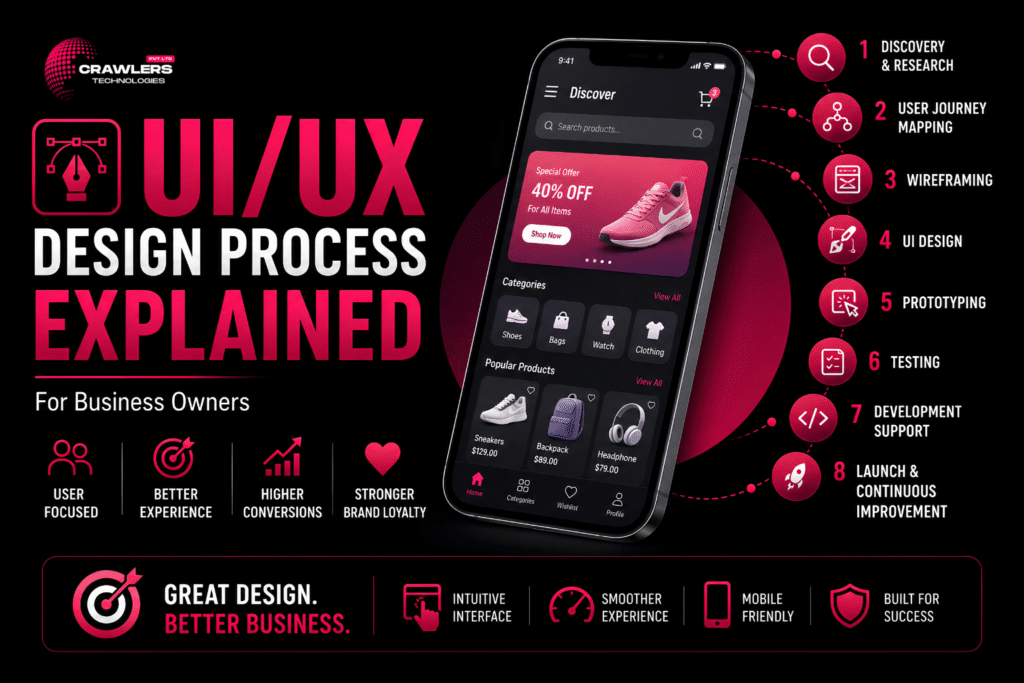
🎨 UI/UX Design Process Explained for Business Owners

🚀 How to Automate Your Business with a Custom App UI UX Design Process 🎨 Business Owner Guide UI/UX Design Process Explained Understand the complete UI/UX workflow from discovery to continuous improvement. 10+ Stages UX User First UI Modern Design 100% Responsive 🚀 What Is UI Design? Visual elements users interact with. Business Impact: Better user experience improves engagement and conversions.DesignUXGrowth💡 What Is UX Design? Overall experience and usability. Business Impact: Better user experience improves engagement and conversions.DesignUXGrowth🤔 Why UI/UX Matters Improves engagement, trust and conversions. Business Impact: Better user experience improves engagement and conversions.DesignUXGrowth📋 Business Discovery Understand goals and audience. Business Impact: Better user experience improves engagement and conversions.DesignUXGrowth👥 User Research Analyze users and pain points. Business Impact: Better user experience improves engagement and conversions.DesignUXGrowth🗺️ User Journey Mapping Map user interactions. Business Impact: Better user experience improves engagement and conversions.DesignUXGrowth✏️ Wireframing Blueprints before visuals. Business Impact: Better user experience improves engagement and conversions.DesignUXGrowth🎨 UI Design Brand colors, typography and components. Business Impact: Better user experience improves engagement and conversions.DesignUXGrowth📱 Interactive Prototyping Clickable experience before coding. Business Impact: Better user experience improves engagement and conversions.DesignUXGrowth🧪 Usability Testing Validate with real users. Business Impact: Better user experience improves engagement and conversions.DesignUXGrowth⚙️ Design Handoff Assets and specs for developers. Business Impact: Better user experience improves engagement and conversions.DesignUXGrowth🚀 Development Support Maintain consistency. Business Impact: Better user experience improves engagement and conversions.DesignUXGrowth📊 Continuous Improvement Iterate with analytics. Business Impact: Better user experience improves engagement and conversions.DesignUXGrowth🎯 Key Principles Simple, fast, consistent. Business Impact: Better user experience improves engagement and conversions.DesignUXGrowth🚨 Common Mistakes Clutter and poor navigation. Business Impact: Better user experience improves engagement and conversions.DesignUXGrowth💼 Why Hire Professionals? Save time and improve quality. Business Impact: Better user experience improves engagement and conversions.DesignUXGrowth 💡 Final Thoughts Good UI/UX creates products people enjoy using while supporting your business goals. Start Your Design Journey Submit your request Recent Post What Is Custom Software?