
🚀 How to Automate Your Business with a Custom App
Client Guide · Software Development
Agile Development
Explained for Clients
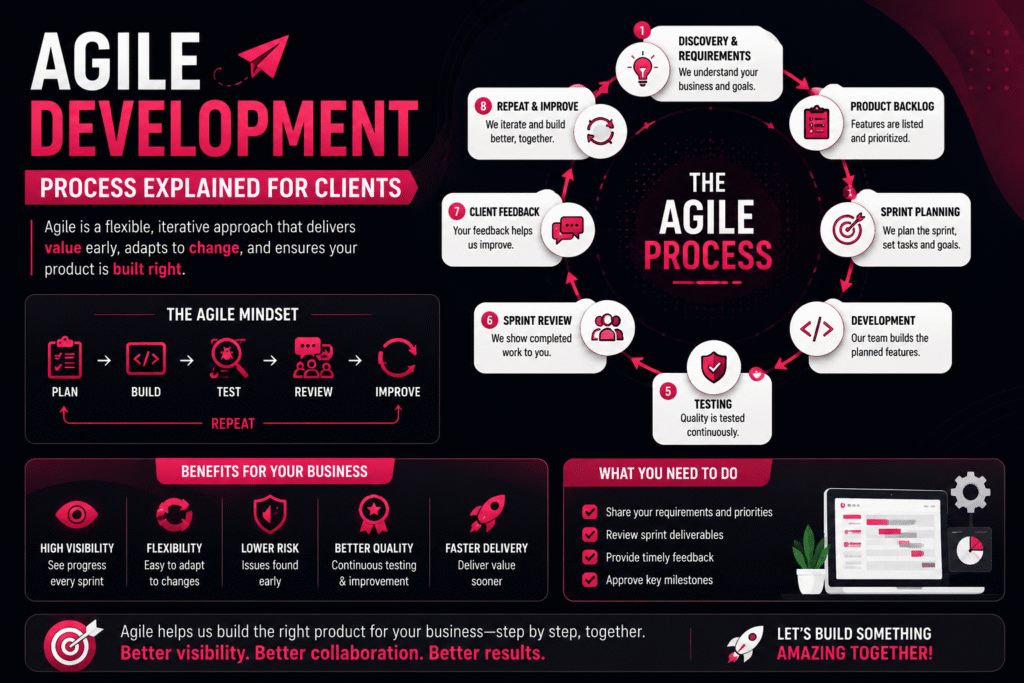
Stop waiting months to see progress. Agile breaks your project into small, reviewable stages so you’re always in control — with feedback at every step.
🔄 Sprints
💬 Feedback Loops
🧪 Continuous Testing
🚀 MVP Launch
📊 vs Traditional
🧠 Myths Busted
Scroll to explore
The Foundation
What Is Agile Development?
Agile is a flexible software development methodology focused on continuous delivery, real client feedback, and incremental improvement — instead of building everything in one go.
Traditional vs Agile — The Core Difference
❌ Traditional
Plan→
Build Everything→
Test→
Launch
You see the result only at the end — months later.
✅ Agile
Plan→
Build→
Test→
Review→
Improve→
Repeat
You see working features every 1–4 weeks.
Agile Core Principles
🔁 Continuous development
💬 Regular client feedback
🧪 Frequent testing
📈 Incremental improvements
🔓 Flexible requirements
The Agile Cycle
🗺️
Plan
→
💻
Build
→
🧪
Test
→
👀
Review
→
💬
Feedback
→
⚡
Improve
↺
How It Works
The Agile Process — Step by Step
An Agile project follows clear, repeatable stages that give you visibility and control throughout the entire build.
Step 01
Discovery & Requirement Gathering
The project begins by deeply understanding your business — goals, customers, features, competitors, budget, and timeline. The output is a clear product roadmap.
Business Goals
Target Customers
Required Features
Budget & Timeline
Technical Requirements
Step 02
Creating the Product Backlog
A prioritized list of everything the application needs. The most important features are developed first, so you always get maximum value early.
Step 03
Sprint Planning
The project is divided into sprints — focused development cycles of 1–4 weeks. During planning, the team decides which features to build, who works on what, and what the sprint goal is.
Building Blocks
Backlog & Sprint Execution
📝 Example Product Backlog — E-Commerce App
Features are listed and prioritised before development begins. High-priority items are built first.
#01User registration
#02Login & auth
#03Product catalog
#04Search
#05Shopping cart
#06Payment
#07Order tracking
#08Push notifications
#09Admin dashboard
💻 Development — During Each Sprint
Developers focus only on the features selected for that sprint — not the whole app. This keeps work focused and quality high.
Frontend development
Backend development
API integration
Database setup
UI implementation
🧪 Testing Throughout Development
Testing happens throughout every sprint — not only at the end. Finding bugs early makes them far cheaper and easier to fix.
✅ Functionality
⚡ Performance
🔒 Security
📱 Device compatibility
😊 User experience
Client Involvement
Sprint Review & Your Feedback
At the end of every sprint, you see real working features — not a presentation or a status report. This is where Agile earns its value for clients.
👀 What You See After Each Sprint
1
Login + Registration
2
Product Catalog + Search
3
Cart + Checkout
4
Payments + Order Tracking
5
Notifications + Admin Panel
💬 How Client Feedback Works
After each sprint review, you share feedback. The team adds your input to the backlog and prioritises it for a future sprint.
“The checkout process should have fewer steps — can we consolidate the address and payment into one screen?”
This kind of real-time feedback ensures the final product is closely aligned with your actual business needs — not a guess made at the start of the project.
Going Live
Product Launch & Continuous Improvement
🚀 What the Launch Includes
📱 Google Play Store submission
🍎 Apple App Store submission
🖥️ Production deployment
⚙️ Server configuration
📊 Analytics setup
🔒 Security checks
💡 Agile doesn’t require waiting for every possible feature. You can launch an MVP and keep improving it based on real user feedback — saving budget and getting to market faster.
🔄 Continuous Improvement After Launch
Agile development doesn’t end at launch. The same cycle continues to evolve and improve the product over time.
Bug fixes
New features
Performance improvements
Security updates
User feedback integration
Business requirement changes
Head to Head
Agile vs Traditional Development
A clear breakdown of how these two approaches differ across every important factor.
| Factor | Agile | Traditional |
|---|---|---|
| Development Style | Incremental | Sequential |
| Client Feedback | Frequent throughout | Often limited during build |
| Testing | Continuous | Concentrated at end |
| Flexibility | High | Lower |
| Progress Visibility | High — see every sprint | Lower — mostly at end |
| Handling Changes | Easier to accommodate | Can be expensive late |
| Product Delivery | Incremental releases | Usually one final delivery |
| Risk | Detected early | May surface late |
Your Part
What Does the Client Need to Do?
Agile doesn’t mean managing developers daily. Your involvement is structured, lightweight, and high-impact.
📋
Provide Requirements
Explain what your business needs at the start and as things evolve
🎯
Prioritize Features
Decide which features are most important for the first release
👀
Review Sprint Work
Check completed features and share honest, timely feedback
⚡
Make Quick Decisions
Fast feedback prevents development delays and keeps momentum
✅
Approve Milestones
Confirm the project is moving in the right direction at key stages
💰 Does Agile Increase Development Cost?
Not necessarily — Agile can actually help you control costs. Because features are built incrementally, you can identify low-value items early and invest only in what matters.
Instead of spending ₹10 lakh building every planned feature, you might launch an MVP first, learn from real users, and invest additional budget only in features that demonstrate real value.
Clearing the Air
Common Misconceptions About Agile
Agile is often misunderstood. Here’s what it actually means — and what it doesn’t.
“Agile means there is no plan.”
Agile involves continuous planning rather than one rigid plan. The roadmap evolves — it never disappears.
“Clients can change anything at any time.”
Agile is flexible, but significant changes still affect scope, cost, and timeline — just less than in traditional development.
“Agile means no deadlines.”
Agile uses sprint goals, milestones, priorities, and delivery schedules. Accountability is built in.
“Agile projects are never finished.”
Agile has clear releases and milestones. Continuous improvement simply allows the product to grow after launch.
Why It Works
Benefits of Agile for Business Owners
For startups and growing businesses, Agile provides the flexibility needed to develop and validate a product efficiently.
⚡
Faster Visibility
See working features throughout development — not just at the end
🔓
Better Flexibility
Requirements can evolve as your business needs change
🔍
Early Problem Detection
Testing and reviews catch issues before they become expensive
🏆
Better Product Quality
Frequent feedback loops continuously improve the final product
🛡️
Reduced Risk
Problems surface before the entire budget is spent
🎯
Business Alignment
The product stays connected to your real business objectives throughout
🧠 When Is Agile a Good Choice?
✔ Building a new mobile app
✔ Requirements may evolve
✔ Developing an MVP
✔ Want frequent progress updates
✔ Customer feedback is important
✔ Building complex software
💡 The Bottom Line
Agile development is not just a methodology for developers — it’s a way of making software development more transparent, flexible, and collaborative for clients.
Instead of waiting months to discover whether the product meets your expectations, Agile allows you to see progress regularly, provide feedback, and make informed decisions at every stage.
Plan → Build → Test → Review → Improve → Repeat
Crawlers Technologies
Mobile App · Web · AI · Digital Marketing · Hubli, Karnataka
Submit your request
🚀 Agile Development Process Explained for Clients
Recent Post
📱 Mobile App Development Services in Bangalore – Complete Guide
August 20, 2026
12:31 pm
Read More »