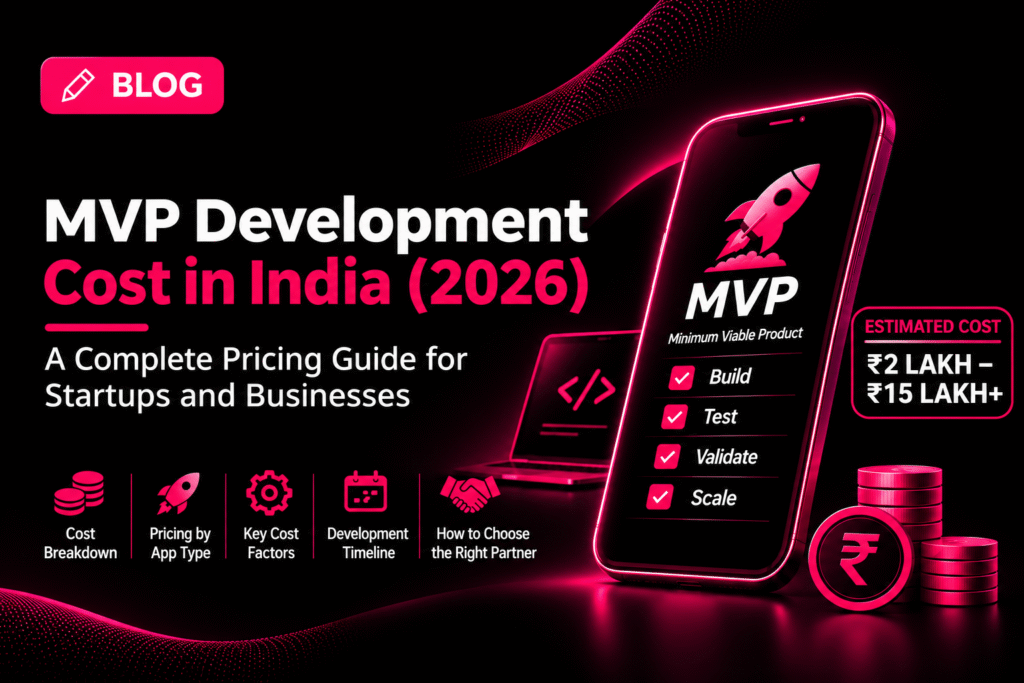


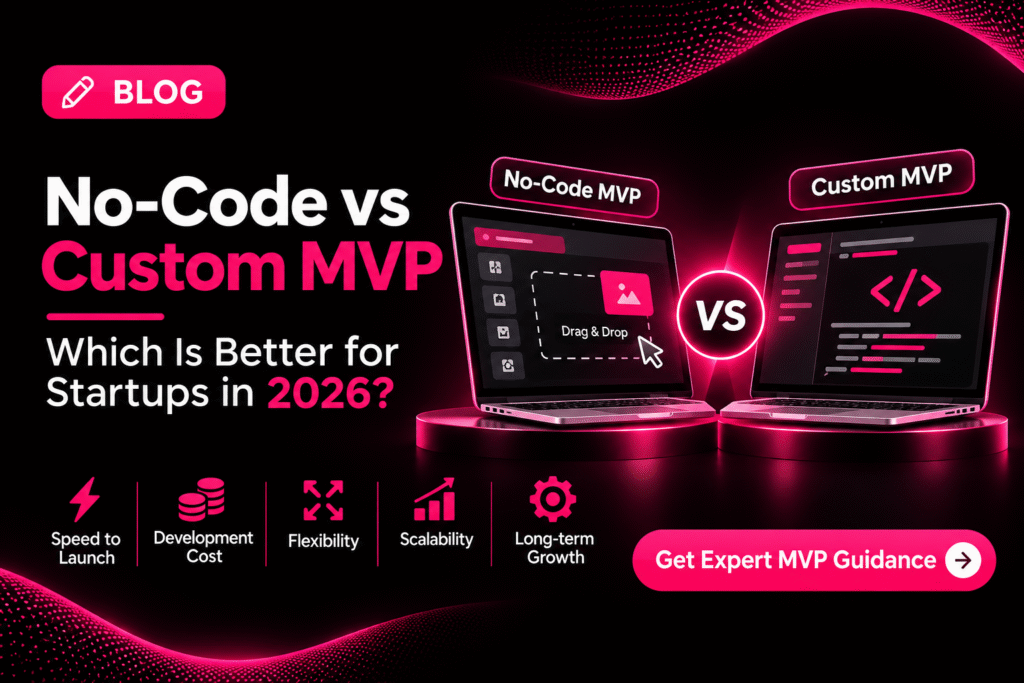
No-Code vs Custom MVP Development: Which Is Better for Startups in 2026?
Should you build your MVP using a no-code platform or invest in custom MVP developmen Both approaches can help startups launch products, test business ideas, and reach early customers. However, they differ significantly in development flexibility, technical control, scalability, integrations, and long-term costs. No-code development allows you to create applications using visual tools with little or no traditional programming. Custom MVP development involves building an application using programming languages and technologies selected according to your business requirements. Choosing the wrong approach can lead to unnecessary expenses, technical limitations, and redevelopment work as your business grows. In this guide, we compare no-code vs custom MVP development, explain their advantages and disadvantages, discuss development costs, and help you choose the right solution for your startup. What Is No-Code MVP Development? No-code MVP development is the process of building a Minimum Viable Product using visual development platforms instead of writing traditional application code. These platforms provide drag-and-drop interfaces, prebuilt components, workflows, database connections, and integrations. This allows founders and businesses to create functional applications without building every component from scratch. Common features of a no-code MVP Depending on the platform, a no-code MVP may include: When should you choose no-code MVP development? No-code development can be suitable when: For example, a startup testing a simple appointment booking concept may be able to launch its first version using a no-code platform. However, more complex requirements may introduce platform limitations. What Is Custom MVP Development? Custom MVP development involves building an application specifically around your business requirements using programming languages, frameworks, databases, and other technologies. Unlike no-code platforms, custom development gives your development team greater control over the application’s architecture, features, integrations, user experience, and future improvements. Common features of a custom MVP A custom MVP can include: When should you choose custom MVP development? Custom MVP development is suitable when: For example, a multi-vendor marketplace with separate customer, seller, and administrator dashboards may require custom development to support its specific workflows. No-Code vs Custom MVP Development: Key Differences Both development approaches can help you launch an MVP, but the right choice depends on your product requirements. Comparison No-Code MVP Custom MVP Development approach Visual development tools Programming and custom architecture Initial development Often faster Depends on project complexity Technical skills Lower coding requirements Requires developers Customisation Platform-dependent Greater flexibility Integrations Depends on available connectors and APIs Can be developed around requirements Scalability Depends on platform capabilities Can be architected for future needs Source code control Platform-dependent Greater control over developed code Maintenance Platform and workflow-dependent Managed through the development team Complex features May have limitations More suitable for complex requirements Platform dependency Often higher Depends on technology choices Important: No-code does not automatically mean cheaper in the long term, and custom development does not automatically mean better. The right decision depends on what you are building. No-Code MVP Development: Advantages and Disadvantages Before choosing a no-code platform, understand its strengths and limitations. Advantages of no-code MVP development 1. Faster initial development Visual tools and prebuilt components can help reduce the time needed to create simple applications. 2. Lower initial investment in some cases For straightforward products, no-code tools may reduce the amount of custom development work required. 3. Less dependence on traditional coding Founders can create basic workflows and prototypes without managing a full development team. 4. Easy experimentation You can test different layouts, workflows, and ideas before committing to a larger development project. 5. Useful for internal business tools No-code platforms can be effective for internal dashboards, forms, basic management systems, and process automation. Disadvantages of no-code MVP development 1. Platform limitations Your application may be restricted by the features and capabilities supported by the selected platform. 2. Limited customisation Advanced workflows and unique functionality may be difficult or expensive to implement. 3. Platform dependency Moving your application to another platform can require redevelopment or data migration. 4. Usage and subscription costs Some platforms charge based on users, workflows, storage, transactions, or usage levels. 5. Complex integrations Certain specialised APIs and integrations may require additional configuration or custom code. No-code is useful for the right product, but it is not the ideal solution for every application. Custom MVP Development: Advantages and Disadvantages Custom MVP development provides greater flexibility when building applications with specific business requirements. Advantages of custom MVP development 1. Greater flexibility Your application can be designed around your business workflows rather than the limitations of a particular platform. 2. Custom functionality You can build features specifically for your target customers and business model. 3. More control over architecture The development team can select suitable technologies, databases, frameworks, and infrastructure. 4. Integration flexibility Custom applications can be developed to connect with different APIs, business systems, and external services. 5. Future expansion A well-designed architecture can support new features and changing business requirements as your product evolves. 6. Greater control over the product You can establish ownership, hosting, access, maintenance, and source code arrangements according to your project agreement. Disadvantages of custom MVP development 1. Higher initial investment in many cases Custom development may require more design, programming, testing, and infrastructure work. 2. Requires technical expertise You need an experienced development team to plan and build the application. 3. Development planning takes time Requirements, architecture, UI/UX design, and testing need proper coordination. 4. Ongoing maintenance Custom applications require maintenance, updates, monitoring, and technical support. Despite these considerations, custom development can be a strong choice when your application requires specialised functionality and long-term flexibility. No-Code vs Custom MVP Development Cost in India One of the most important questions for startup founders is the cost of building an MVP. The cost depends on the number of features, application complexity, integrations, development approach, and platform requirements. Here is an indicative planning comparison for India. Development type Indicative budget Simple no-code MVP ₹50,000 – ₹3 lakh Advanced no-code MVP ₹2 lakh – ₹5 lakh+ Basic custom MVP ₹2 lakh – ₹5 lakh Standard custom MVP ₹3 lakh – ₹8 lakh Complex custom MVP ₹8 lakh –