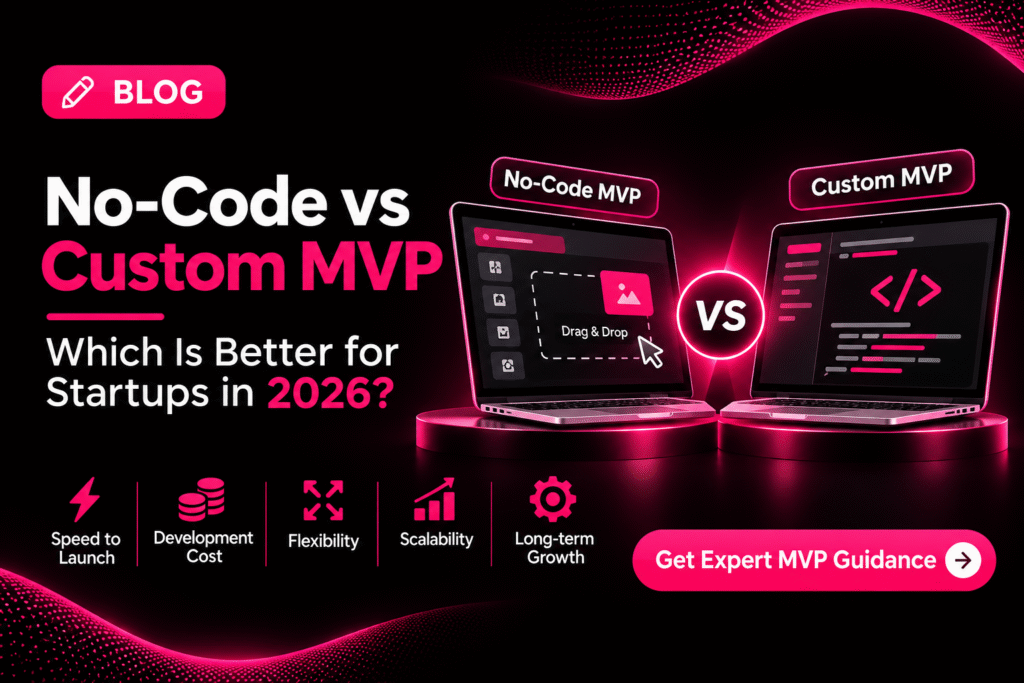
Should you build your MVP using a no-code platform or invest in custom MVP developmen
Both approaches can help startups launch products, test business ideas, and reach early customers. However, they differ significantly in development flexibility, technical control, scalability, integrations, and long-term costs.
No-code development allows you to create applications using visual tools with little or no traditional programming. Custom MVP development involves building an application using programming languages and technologies selected according to your business requirements.
Choosing the wrong approach can lead to unnecessary expenses, technical limitations, and redevelopment work as your business grows.
In this guide, we compare no-code vs custom MVP development, explain their advantages and disadvantages, discuss development costs, and help you choose the right solution for your startup.
What Is No-Code MVP Development?
No-code MVP development is the process of building a Minimum Viable Product using visual development platforms instead of writing traditional application code.
These platforms provide drag-and-drop interfaces, prebuilt components, workflows, database connections, and integrations.
This allows founders and businesses to create functional applications without building every component from scratch.
Common features of a no-code MVP
Depending on the platform, a no-code MVP may include:
- User registration and login
- Forms and data collection
- Basic dashboards
- Booking functionality
- Workflow automation
- Payment integrations
- Customer management
- Notifications
- Basic reporting
When should you choose no-code MVP development?
No-code development can be suitable when:
- You want to test a business idea quickly.
- Your application has simple workflows.
- You have a limited initial budget.
- You want to validate customer demand.
- You do not need extensive custom functionality.
- You want to build an internal business tool.
For example, a startup testing a simple appointment booking concept may be able to launch its first version using a no-code platform.
However, more complex requirements may introduce platform limitations.
What Is Custom MVP Development?
Custom MVP development involves building an application specifically around your business requirements using programming languages, frameworks, databases, and other technologies.
Unlike no-code platforms, custom development gives your development team greater control over the application’s architecture, features, integrations, user experience, and future improvements.
Common features of a custom MVP
A custom MVP can include:
- Custom user registration and authentication
- Personalised dashboards
- Advanced search and filtering
- Payment gateway integration
- Multiple user roles
- Custom booking and ordering systems
- API integrations
- Real-time functionality
- Admin management systems
- Advanced reporting and analytics
When should you choose custom MVP development?
Custom MVP development is suitable when:
- Your business requires unique functionality.
- You need complex workflows.
- You want greater control over application architecture.
- Your product depends on third-party API integrations.
- You need specific security or data management requirements.
- You plan to expand your application with advanced features.
- Your application is central to your long-term business model.
For example, a multi-vendor marketplace with separate customer, seller, and administrator dashboards may require custom development to support its specific workflows.
No-Code vs Custom MVP Development: Key Differences
Both development approaches can help you launch an MVP, but the right choice depends on your product requirements.
| Comparison | No-Code MVP | Custom MVP |
|---|---|---|
| Development approach | Visual development tools | Programming and custom architecture |
| Initial development | Often faster | Depends on project complexity |
| Technical skills | Lower coding requirements | Requires developers |
| Customisation | Platform-dependent | Greater flexibility |
| Integrations | Depends on available connectors and APIs | Can be developed around requirements |
| Scalability | Depends on platform capabilities | Can be architected for future needs |
| Source code control | Platform-dependent | Greater control over developed code |
| Maintenance | Platform and workflow-dependent | Managed through the development team |
| Complex features | May have limitations | More suitable for complex requirements |
| Platform dependency | Often higher | Depends on technology choices |
Important: No-code does not automatically mean cheaper in the long term, and custom development does not automatically mean better. The right decision depends on what you are building.
No-Code MVP Development: Advantages and Disadvantages
Before choosing a no-code platform, understand its strengths and limitations.
Advantages of no-code MVP development
1. Faster initial development
Visual tools and prebuilt components can help reduce the time needed to create simple applications.
2. Lower initial investment in some cases
For straightforward products, no-code tools may reduce the amount of custom development work required.
3. Less dependence on traditional coding
Founders can create basic workflows and prototypes without managing a full development team.
4. Easy experimentation
You can test different layouts, workflows, and ideas before committing to a larger development project.
5. Useful for internal business tools
No-code platforms can be effective for internal dashboards, forms, basic management systems, and process automation.
Disadvantages of no-code MVP development
1. Platform limitations
Your application may be restricted by the features and capabilities supported by the selected platform.
2. Limited customisation
Advanced workflows and unique functionality may be difficult or expensive to implement.
3. Platform dependency
Moving your application to another platform can require redevelopment or data migration.
4. Usage and subscription costs
Some platforms charge based on users, workflows, storage, transactions, or usage levels.
5. Complex integrations
Certain specialised APIs and integrations may require additional configuration or custom code.
No-code is useful for the right product, but it is not the ideal solution for every application.
Custom MVP Development: Advantages and Disadvantages
Custom MVP development provides greater flexibility when building applications with specific business requirements.
Advantages of custom MVP development
1. Greater flexibility
Your application can be designed around your business workflows rather than the limitations of a particular platform.
2. Custom functionality
You can build features specifically for your target customers and business model.
3. More control over architecture
The development team can select suitable technologies, databases, frameworks, and infrastructure.
4. Integration flexibility
Custom applications can be developed to connect with different APIs, business systems, and external services.
5. Future expansion
A well-designed architecture can support new features and changing business requirements as your product evolves.
6. Greater control over the product
You can establish ownership, hosting, access, maintenance, and source code arrangements according to your project agreement.
Disadvantages of custom MVP development
1. Higher initial investment in many cases
Custom development may require more design, programming, testing, and infrastructure work.
2. Requires technical expertise
You need an experienced development team to plan and build the application.
3. Development planning takes time
Requirements, architecture, UI/UX design, and testing need proper coordination.
4. Ongoing maintenance
Custom applications require maintenance, updates, monitoring, and technical support.
Despite these considerations, custom development can be a strong choice when your application requires specialised functionality and long-term flexibility.
No-Code vs Custom MVP Development Cost in India
One of the most important questions for startup founders is the cost of building an MVP.
The cost depends on the number of features, application complexity, integrations, development approach, and platform requirements.
Here is an indicative planning comparison for India.
| Development type | Indicative budget |
|---|---|
| Simple no-code MVP | ₹50,000 – ₹3 lakh |
| Advanced no-code MVP | ₹2 lakh – ₹5 lakh+ |
| Basic custom MVP | ₹2 lakh – ₹5 lakh |
| Standard custom MVP | ₹3 lakh – ₹8 lakh |
| Complex custom MVP | ₹8 lakh – ₹15 lakh+ |
These figures are illustrative estimates, not fixed market quotations. Actual pricing depends on the scope, platform subscriptions, design, integrations, infrastructure, and development requirements.
What affects MVP development cost?
Several factors influence the final project budget:
- Number of application features
- UI/UX design complexity
- Android, iOS, or web platform requirements
- Backend and database functionality
- Payment gateway integrations
- Third-party APIs
- User roles and permissions
- Security requirements
- Testing and deployment
- Maintenance and technical support
A simple product with a few essential workflows may be suitable for no-code development. An application with complex business logic may justify the investment in custom development.
Which Is Better for Startups: No-Code or Custom MVP?
There is no universal answer. The right approach depends on your business model and product requirements.
Consider these examples.
Example 1: Appointment Booking Application
Imagine you want to develop an appointment booking platform for a small business.
Your first version requires:
- Customer registration
- Service listings
- Appointment selection
- Booking confirmation
- Basic admin dashboard
A no-code MVP may be sufficient if the platform supports all required workflows.
However, if you need complex scheduling rules, multiple business locations, custom integrations, and advanced user roles, custom development may be more suitable.
Example 2: Multi-Vendor Marketplace
Imagine you want to build a marketplace connecting multiple sellers with customers.
Your application may require:
- Customer and seller registration
- Separate dashboards
- Product management
- Order processing
- Commission calculations
- Payment distribution
- Seller verification
- Advanced administration
This type of application often benefits from custom MVP development because of its business logic and integration requirements.
Example 3: SaaS Business Application
Suppose you want to create a subscription-based software product.
You may require:
- Account management
- Subscription plans
- User permissions
- Billing integration
- Data management
- Reporting
- Automated workflows
A no-code platform may work for validating a simple version. Custom development may be more appropriate when the product requires specialised functionality or more control over its architecture.
Can You Start With No-Code and Switch to Custom Development Later?
Yes. Many businesses can begin by validating a concept using no-code tools and later invest in custom development.
However, moving from no-code to custom development is not always a simple conversion.
Depending on the platform, you may need to:
- Export and migrate application data.
- Rebuild user authentication.
- Recreate workflows.
- Develop custom backend functionality.
- Rebuild the user interface.
- Reconnect third-party integrations.
- Test the new application.
Before choosing a no-code platform, check its data export options, integration capabilities, ownership terms, and migration limitations.
If you already know that your product will require complex functionality, planning custom development from the beginning may reduce future redevelopment work.
7 Questions to Ask Before Choosing Your MVP Development Approach
Before investing in no-code or custom development, answer these questions.
- What exact problem will my application solve?
- Who are my first target customers?
- What are the essential features required for launch?
- Does my product require complex integrations?
- Will I need multiple user roles and dashboards?
- What are my expected product requirements over the next two years?
- What is my initial development budget?
Your answers will help determine whether no-code or custom development is appropriate.
Do not choose a development approach simply because it is popular or appears inexpensive. Choose the one that supports your actual business requirements.
How to Choose the Right MVP Development Company in India
If you decide that custom MVP development is the right approach, selecting the right development partner becomes important.
Before hiring an MVP development company in India, evaluate the following:
1. Technical expertise: Check experience in mobile applications, web applications, backend development, and integrations.
2. Previous projects: Review relevant applications and development experience.
3. Transparent pricing: Ask for a clear breakdown of features, deliverables, milestones, and additional costs.
4. Requirement analysis: Choose a team that understands your business problem before suggesting technologies.
5. Development process: Understand how design, development, testing, and deployment will be managed.
6. Source code ownership: Confirm ownership of source code, design files, credentials, and project documentation.
7. Post-launch support: Discuss maintenance, bug fixes, updates, and technical support.
The right development partner should help you make informed decisions rather than simply encourage you to build more features.
Why Choose Crawlers Technologies for Custom MVP Development?
At Crawlers Technologies, we help startups and businesses turn their ideas into functional digital products through custom mobile application, web application, and software development.
We focus on understanding your business requirements and identifying the right development approach for your product.
Our development services include:
- Custom mobile app development
- Android and iOS application development
- Web application development
- SaaS application development
- E-commerce application development
- Marketplace development
- Booking and service applications
- Custom software development
- AI-powered application development
Whether you are validating your first startup idea or building a specialised business application, our team can help you plan the essential features and select a suitable technology approach.
We focus on building applications around real business requirements, with attention to functionality, usability, and future development needs.
Frequently Asked Questions
1. What is the difference between no-code and custom MVP development?
No-code MVP development uses visual platforms and prebuilt components to create applications with little or no traditional programming. Custom MVP development involves building software using programming languages and technologies selected for specific business requirements.
2. Is no-code MVP development cheaper?
No-code development can be less expensive initially for simple applications. However, subscription fees, usage charges, integrations, and platform limitations can affect long-term costs.
3. Is custom MVP development better for startups?
Custom development can be a better choice for startups that need specialised features, complex workflows, greater technical control, and a product designed around specific business requirements.
4. Can I build a mobile app without coding?
Yes. Several no-code platforms allow users to create mobile applications through visual interfaces. The available features and deployment options depend on the platform.
5. How much does custom MVP development cost in India?
A basic custom MVP may cost approximately ₹2 lakh to ₹5 lakh, while more advanced products can cost ₹8 lakh to ₹15 lakh or more. The final estimate depends on the project scope and technical requirements.
6. How long does it take to develop an MVP?
A focused MVP may take around 6–12 weeks, while more complex applications may require additional development time. The timeline depends on features, integrations, design, and testing.
7. Can a no-code MVP scale as my business grows?
Some no-code platforms can support growing applications, but scalability depends on platform capabilities, architecture, integrations, usage limits, and performance requirements.
8. When should I move from no-code to custom development?
Consider moving when your application reaches platform limitations, requires specialised functionality, needs greater control over its architecture, or has integration and performance requirements that the existing platform cannot adequately support.
9. Which is better for a SaaS startup: no-code or custom development?
No-code can be useful for validating a simple SaaS concept. Custom development may be more suitable for specialised SaaS products requiring complex subscriptions, permissions, integrations, and business logic.
10. How do I choose an MVP development company in India?
Evaluate the company’s technical expertise, relevant project experience, pricing transparency, development process, source code ownership, and post-launch support.
Ready to Build Your MVP? Let’s Choose the Right Development Approach!
Still confused between no-code and custom MVP development?
The right decision can help you avoid unnecessary development costs, reduce technical limitations, and build a product that supports your business goals.
At Crawlers Technologies, we help startups and businesses plan and develop custom mobile applications, web applications, SaaS platforms, and business software.
Let’s understand your idea, identify the essential features, and recommend a suitable development approach.
GET YOUR FREE MVP DEVELOPMENT CONSULTATION
Crawlers Technologies
Website: https://crawlerstechnologies.com/
Contact: +91 97387 38578
Have an idea? Let’s turn it into a working product.