

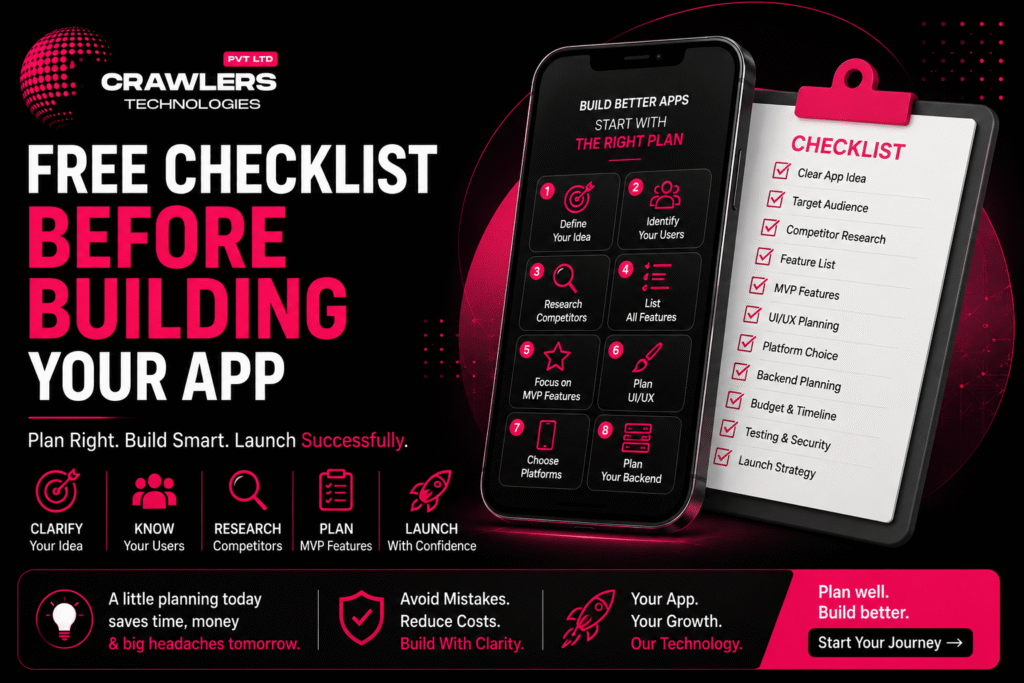
📱 Free Checklist Before Building Your App
🚀 How to Automate Your Business with a Custom App Free Checklist Before Building Your App | Crawlers Technologies 0 / 0 completed Intro Define Your Idea Features & MVP Tech & Backend Budget & Timeline Security & Testing Partner & Launch Full Checklist Final Thoughts Free Resource · App Planning Free ChecklistBefore Building Your App Don’t spend a rupee on development until these questions are answered. This interactive checklist covers everything — from idea to launch — so your app project starts right. 💡 Idea Definition 🎯 Target Users 📝 Features & MVP 📱 Platform Choice 💰 Budget Planning 🔐 Security 🧪 Testing 🚀 Launch Strategy Click each item to check it off Steps 1 – 3 01Define Your App Idea Before talking to developers, clearly explain what your app is supposed to do. If you cannot explain your idea in one sentence, spend more time on the planning stage first. I can explain my app idea in one sentence I know the specific problem I’m solving I know my target audience I understand my app’s main purpose I know what makes my idea different from competitors 02Identify Your Target Users Your app should be designed for a specific audience. An app for college students has very different requirements from one built for business owners. Age groupLocationCustomer type InterestsProblemsTech preferences Target audience clearly identified Customer problems understood User behaviour and buying patterns researched User expectations identified 03Research Your Competitors Don’t build your app without studying similar products. Negative reviews are goldmines — they reveal problems your competitors haven’t solved yet. Google Play Store Apple App Store Google Search Social media Competitors identified and listed Competitor features compared Customer reviews — especially negative ones — studied Competitor weaknesses identified My unique competitive advantage defined Steps 4 – 6 04Create a Feature List Write down every feature you’re considering — then separate them into essential and future categories. Don’t build everything in version one. ✅ Essential Features (Build Now) User registration & login Core product or service listing Search & filter Checkout & payment Order / booking tracking Push notifications ◇ Future Features (Build Later) AI-powered recommendations Loyalty & referral programs Advanced analytics Voice search Multi-language support Social sharing 05Decide Your MVP Features An MVP (Minimum Viable Product) is the first version containing only the features needed to test the idea. It reduces initial cost and validates the concept before full investment. “If I could launch with only 5 features, which ones would they be?” — Those are your MVP features. Core problem clearly identified Must-have features listed and agreed Nice-to-have features separated from essentials Future features documented for later phases MVP scope finalized and agreed with team 06Plan Your UI/UX Before development starts, map how users will move through the app. You don’t need a final design — a basic user flow makes developer discussions far easier and more accurate. Open App → Sign Up → Browse → Select → Action → Confirmation Main screens identified User journey mapped from open to completion Navigation structure planned Branding requirements defined (logo, colours, fonts) UI/UX requirements discussed with development team Steps 7 – 9 07Choose Your Platform Decide where your app needs to be available. The right choice depends on your audience, performance requirements, features, budget, and long-term plans. 🤖 Android Best when your target audience primarily uses Android devices 🍎 iOS Important when your audience includes significant iPhone users 💙 Both (Flutter) Cross-platform for broad coverage at lower development cost 08Plan Your Backend Many businesses focus only on the mobile interface and forget the backend. A strong backend foundation becomes critical as your app grows. Ask your development company: “What backend architecture will this app need?” 👤 User accounts 🗄️ Databases 💳 Payments 📦 Orders 🔔 Notifications 🔑 Authentication ⚙️ Business logic 📊 Reports 09List Required Integrations Create a complete list of all third-party services before development begins. This helps your team estimate the project more accurately — and avoids nasty surprises mid-build. 💳 Payment gateways 🗺️ Google Maps 💬 WhatsApp API 📱 SMS providers 📧 Email services 🗄️ CRM / ERP 📊 Accounting software 🔐 Social login ☁️ Cloud storage 📈 Analytics tools Android / iOS platform requirements decided Technology approach (Native / Flutter / React Native) discussed Backend requirements identified and documented All required APIs and integrations listed Steps 10 – 11 10Set a Realistic Budget Don’t consider only the development cost. Your total app investment includes much more than what a developer quotes you on day one. ❌ Wrong Question “How much does it cost to build the app?” ✅ Right Question “How much will it cost to build, launch, operate, and grow the app?” 🎨 UI/UX design 💻 App development ⚙️ Backend development 🧪 Testing ☁️ Cloud hosting 🌐 Domain 🔗 API costs 💳 Payment gateway fees 📱 App Store fees 🔧 Maintenance 📣 Marketing Development budget set with realistic expectations Hosting and cloud infrastructure costs considered API and third-party service costs included Ongoing maintenance budget planned App marketing budget allocated 11Define Your Timeline Set realistic expectations. A simple MVP takes far less time than a complex marketplace or enterprise application. Target launch date defined and agreed MVP deadline defined Development milestones planned Testing period included in the schedule App Store submission time accounted for (7–14 days) Steps 12 – 14 12Think About Security Security is not an afterthought. If your app handles financial, healthcare, personal, or business information, security planning starts before a single line of code is written. User authentication method decided (OTP, email, social) Data encryption requirements discussed Secure APIs planned from day one Payment security requirements identified Role-based access control planned Database security and backups included 13Plan for Testing Never assume an app is ready just because coding is complete. Testing should catch bugs before your customers do — not after. Functional testing included in project plan UI and usability testing planned Performance and load testing included Device compatibility testing across Android and iOS API and integration testing planned Security testing included