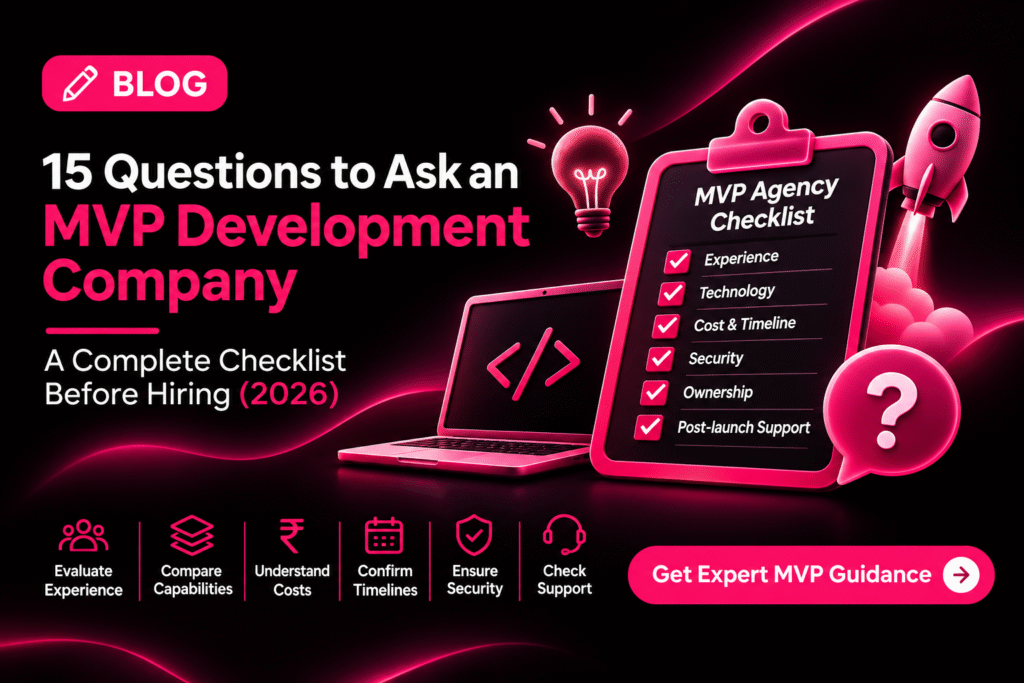
15 Questions to Ask an MVP Development Company Before Hiring (2026)
You have a business idea. You have identified a problem worth solving, and now you are ready to turn that idea into a mobile app, web application, or SaaS product.
But there is one important decision you should not rush: choosing the right MVP development company.
Hiring the wrong development partner can lead to unexpected expenses, missed deadlines, poor application quality, communication problems, and even ownership disputes.
A professional development company should do more than simply write code. It should understand your business goals, help prioritise essential features, recommend suitable technologies, and guide your product from idea to launch.
So, before signing a contract or investing your development budget, what should you ask?
In this guide, we cover 15 important questions to ask an MVP development company before hiring, including questions about pricing, experience, technology, development timelines, security, source code ownership, and post-launch support.
Whether you are a first-time founder or an established business planning a new digital product, these questions will help you make a more informed decision.
Why Is Choosing the Right MVP Development Company Important?
An MVP, or Minimum Viable Product, is the first functional version of your application that includes the essential features needed to solve a specific customer problem.
The objective is to launch a usable product, collect feedback from real customers, validate your business idea, and decide what to develop next.
However, developing an MVP requires more than technical expertise.
Your development partner should understand:
- Your business model
- Your target audience
- The problem your application solves
- Essential product features
- Your development budget
- Your expected launch timeline
- Your future product requirements
Choosing the right MVP development company can help you avoid unnecessary features, manage development expenses, and establish a practical foundation for future growth.
15 Questions to Ask an MVP Development Company Before Hiring
Before selecting an agency, use these questions to evaluate its experience, development process, technical capabilities, and reliability.
1. Have You Developed Similar Applications Before?
This should be one of your first questions.
An agency may have experience building websites, but that does not automatically mean it has experience developing complex mobile applications, SaaS platforms, or marketplace products.
Ask the company:
- Have you developed applications similar to my idea?
- Can you show relevant project examples?
- What challenges did you face during development?
- What functionality did those applications include?
Look for relevant experience rather than simply counting the number of projects completed.
Why it matters: Previous experience with similar products can help the development team understand your requirements and identify potential technical challenges.
2. How Will You Understand My Business Requirements?
A reliable MVP development company should understand your business before recommending a technical solution.
Ask:
- Will you conduct a requirement analysis?
- Will you help identify my target audience?
- Can you help define the MVP scope?
- Will you recommend which features should be included in the first version?
For example, if you want to develop a food delivery application, the agency should understand your customers, restaurants, ordering process, payments, and delivery requirements.
It should not simply provide a quotation based on a one-line description.
Why it matters: Proper requirement analysis helps prevent misunderstandings and unnecessary development work.
3. How Will You Decide Which Features Are Essential for My MVP?
One common mistake startups make is trying to build every possible feature in their first application.
Ask the development company how it prioritises features.
A practical approach is to divide features into:
- Must-have features
- Should-have features
- Future enhancements
For example, a booking application may initially require user registration, service listings, booking management, and an admin dashboard.
Advanced analytics, loyalty rewards, and AI recommendations may be introduced later.
Why it matters: Feature prioritisation helps control the initial development scope and budget.
4. What Is the Estimated MVP Development Cost?
Understanding the complete MVP development cost is essential before starting a project.
Ask the agency for a detailed quotation covering:
- UI/UX design
- Frontend development
- Backend development
- Database development
- Third-party integrations
- Testing and quality assurance
- Deployment
- Maintenance and support
Also ask whether the quotation includes hosting, software licences, API usage, or other recurring charges.
Do not compare companies based only on their final quoted amount. Compare what each quotation actually includes.
Why it matters: Transparent pricing helps you plan your budget and avoid unexpected expenses.
5. How Long Will It Take to Develop and Launch My MVP?
Your development timeline should be realistic and based on the agreed project scope.
Ask:
- What is the estimated delivery timeline?
- What are the major development milestones?
- When will I see the first working version?
- How frequently will progress be shared?
- What could delay the launch?
A typical focused MVP may take approximately 6–12 weeks, although complex applications can require more time.
Why it matters: A clear timeline helps you plan product launches, marketing activities, and business operations.
6. Which Technology Stack Will You Use?
Technology selection can influence your application’s performance, development process, maintenance, and future expansion.
Ask the agency:
- Which programming languages will you use?
- Which frontend and backend technologies do you recommend?
- Which database will support the application?
- Why are these technologies suitable for my requirements?
- Will the application support future integrations?
Depending on your project, the development team may recommend technologies such as Flutter, React Native, React, Node.js, or other suitable frameworks.
The right technology should be selected based on your requirements rather than popularity alone.
Why it matters: Suitable technology choices can help create a maintainable application that supports your product roadmap.
7. Will My Application Be Scalable in the Future?
Your MVP may start with a limited number of users, but your business requirements can change as the product grows.
Ask how the application will handle:
- Increasing user registrations
- Growing database requirements
- Additional application features
- More user roles
- New third-party integrations
- Increased traffic
Also ask what architectural decisions are being made for future expansion.
Why it matters: Planning for reasonable future growth can reduce the need for unnecessary redevelopment.
8. How Will You Protect My Application Data?
Security should be considered from the beginning of the development process.
Ask the development company:
- How will user authentication be managed?
- How will application data be protected?
- Will access permissions be implemented?
- How will databases and backups be managed?
- How will API access be secured?
- What security testing will be performed?
If your application handles sensitive customer information, discuss the relevant privacy and compliance requirements as well.
Why it matters: Good security practices help protect customer information and reduce avoidable risks.
9. Who Will Own the Source Code?
This is one of the most important questions to ask before signing a development agreement.
Clarify:
- Who will own the application source code?
- Will I receive access to the code repository?
- Will I receive the database and deployment documentation?
- Who will own the design files?
- Will I receive the required credentials?
- Can another development team maintain the application in the future?
Make sure ownership and access arrangements are clearly documented in your agreement.
Why it matters: Clear ownership terms give your business greater control over its digital product.
10. Will You Integrate Third-Party APIs and Services?
Many modern applications depend on external services.
Depending on your business requirements, you may need:
- Payment gateways
- Google Maps
- SMS and OTP services
- Email notifications
- WhatsApp integrations
- Analytics platforms
- AI APIs
- CRM integrations
Ask whether the agency has experience integrating these services and whether additional subscription or usage charges apply.
Why it matters: Integration requirements can influence development costs, technical complexity, and launch timelines.
11. How Will You Test My Application Before Launch?
An application should not be launched without proper testing.
Ask about the company’s quality assurance process.
Important testing activities may include:
- Functional testing
- UI testing
- Device compatibility testing
- API testing
- Performance testing
- Security testing
- User acceptance testing
Also ask how bugs will be reported, prioritised, and fixed.
Why it matters: Proper testing helps ensure that essential features work as expected before customers start using the product.
12. How Will I Track Project Progress?
Communication is an important part of any development project.
Ask:
- Will I receive regular progress updates?
- Can I review development milestones?
- Will I have a dedicated point of contact?
- How will feedback and revisions be handled?
- Will I get access to project management tools?
A good development partner should make project progress understandable and transparent.
Why it matters: Regular communication reduces confusion and helps you stay involved in important product decisions.
13. What Happens If I Want to Add New Features During Development?
Business requirements can change as you learn more about your customers.
However, adding features during development can affect the agreed timeline and budget.
Ask the agency:
- How are new feature requests handled?
- Will additional features require a separate quotation?
- How will changes affect delivery milestones?
- Can future features be added after launch?
Make sure the company follows a clear change management process.
Why it matters: A documented process helps prevent uncontrolled scope changes and unexpected expenses.
14. What Support Will You Provide After Launch?
Application development does not end when the product goes live.
Your application may require bug fixes, software updates, infrastructure monitoring, and new functionality.
Ask:
- Is post-launch support included?
- How long is the support period?
- Are bug fixes included?
- What are the maintenance charges?
- Who should I contact if an issue occurs?
- Can the application be upgraded in the future?
Get the support terms in writing before starting the project.
Why it matters: Reliable post-launch support helps maintain your application after customers begin using it.
15. Why Should I Choose Your Company Over Other MVP Development Agencies?
Finally, give the agency an opportunity to explain its approach.
Ask what makes its development process suitable for your business.
Evaluate:
- Relevant technical experience
- Requirement analysis
- Transparent pricing
- Communication
- Project management
- Security practices
- Source code ownership
- Post-launch support
Avoid selecting a development partner based only on promises or the lowest quotation.
Choose a company that understands your business goals and can explain how it plans to achieve them.
Red Flags to Watch Out for When Hiring an MVP Development Company
Knowing what to ask is important, but knowing what to avoid is equally valuable.
Watch out for these warning signs:
1. Unrealistically low quotations: A very low price without a detailed scope may indicate missing features, hidden costs, or unclear deliverables.
2. Guaranteed results without understanding requirements: Be cautious if a company promises an exact timeline or outcome before evaluating your project.
3. No relevant project experience: Ask for genuine examples of previous work.
4. Unclear source code ownership: Never leave intellectual property and access arrangements ambiguous.
5. No documented development scope: A project should have agreed requirements, deliverables, and milestones.
6. Poor communication: If an agency is difficult to reach before the project begins, consider how it may communicate during development.
7. No post-launch support plan: Understand how bugs, maintenance, and future updates will be handled.
How to Compare Two MVP Development Companies
If you have shortlisted multiple agencies, use a structured comparison instead of choosing based on price alone.
| Evaluation factor | Company A | Company B |
|---|---|---|
| Relevant project experience | Check | Check |
| Requirement analysis | Check | Check |
| Transparent quotation | Check | Check |
| Technology expertise | Check | Check |
| Development timeline | Check | Check |
| Source code ownership | Check | Check |
| Testing process | Check | Check |
| Security practices | Check | Check |
| Communication | Check | Check |
| Post-launch support | Check | Check |
Compare the actual proposals and ask follow-up questions wherever the scope or terms are unclear.
Why Choose Crawlers Technologies for MVP Development?
Choosing an MVP development company is not just about finding developers. It is about finding a team that understands your business idea and helps turn it into a functional digital product.
At Crawlers Technologies, we help startups and businesses build digital solutions through custom application and software development.
Our services include:
- Custom mobile application development
- Android and iOS app development
- Web application development
- SaaS product development
- E-commerce application development
- Marketplace application development
- Booking and service applications
- AI-powered application development
- Custom software development
We focus on understanding your business requirements, identifying essential features, and planning an application that supports your business objectives.
Whether you are building your first startup application or developing a new digital platform for an established business, our team can help you plan the right development approach.
Frequently Asked Questions About Hiring an MVP Development Company
1. What should I ask an MVP development company before hiring?
Ask about previous projects, technical expertise, MVP scope, development costs, timelines, technology stack, source code ownership, security, testing, and post-launch support.
2. How do I choose the best MVP development company in India?
Evaluate the company’s relevant experience, technical capabilities, pricing transparency, communication, development process, ownership terms, and maintenance support.
3. How much does it cost to hire an MVP development company?
The cost depends on application complexity, features, platform requirements, integrations, and development scope. A focused MVP may cost a few lakh rupees, while more complex products can require a significantly larger budget.
4. How long does MVP application development take?
A focused MVP may take approximately 6–12 weeks. More complex applications can require additional time depending on their features and technical requirements.
5. Should I choose a freelancer or an MVP development agency?
A freelancer may be suitable for a narrowly defined project. An agency may offer a broader team covering design, frontend, backend, testing, project management, and maintenance. Choose based on your project’s complexity and support requirements.
6. What documents should I receive from an MVP development company?
Depending on the agreement, you should clarify access to the requirements document, design files, source code, repository, technical documentation, deployment details, and credentials.
7. Should an MVP development company provide post-launch support?
Yes, you should discuss maintenance and technical support before signing the agreement. Confirm what is included, the support period, response arrangements, and additional charges.
8. Can an MVP development company help define my app features?
Yes. An experienced development partner can work with you to identify business requirements, prioritise essential features, and prepare an MVP scope before development starts.
9. What is the difference between an MVP development company and a regular app development company?
An MVP-focused development approach places particular emphasis on feature prioritisation, early product validation, and launching a focused first version. A general app development company may handle a wider range of application projects.
10. How can I get an MVP development quotation?
Prepare a brief describing your business idea, target customers, required features, preferred platform, and expected launch timeline. Share it with a development company to receive a project-specific estimate.
Ready to Build Your MVP? Talk to Crawlers Technologies!
Choosing the right development partner can make a major difference to your product journey.
Before investing in your application, make sure you understand the development scope, estimated cost, timeline, technology, source code ownership, and post-launch support.
At Crawlers Technologies, we help startups and businesses transform ideas into functional digital products through custom mobile app development, web application development, and software development services.
Have an idea but unsure where to start?
Let’s discuss your requirements, identify the essential features, and plan the right MVP development approach for your business.
GET YOUR FREE MVP DEVELOPMENT CONSULTATION
Crawlers Technologies
Website: https://crawlerstechnologies.com/
Contact: +91 97387 38578
Your idea deserves the right development partner. Let’s build it together.