

🚀 How to Automate Your Business with a Custom App
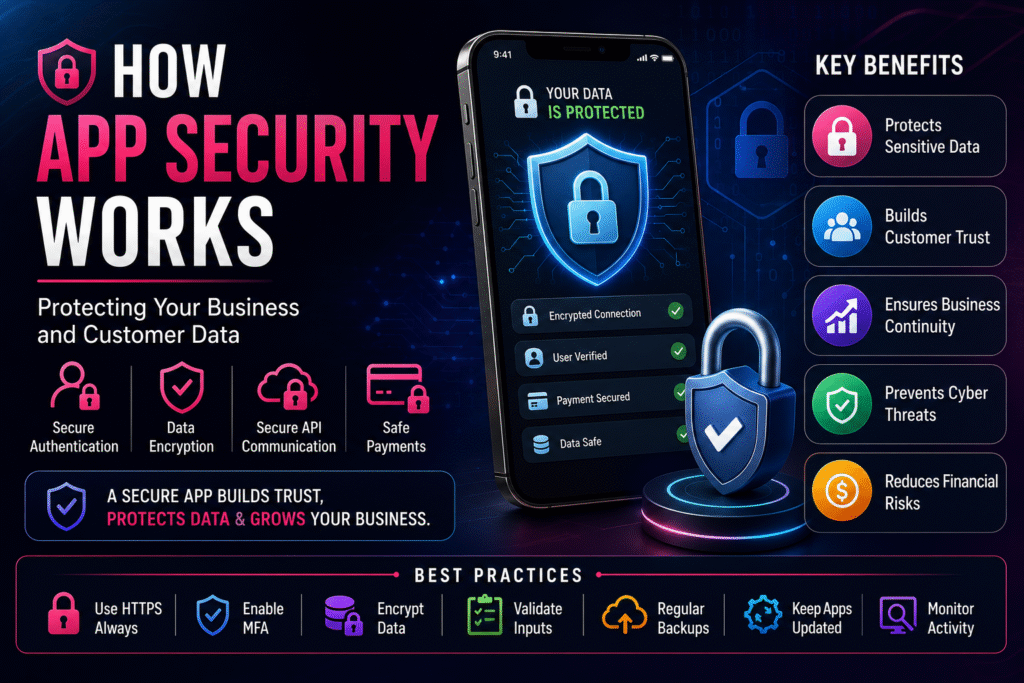
🔐 How App Security Works
Protecting your business and customer data requires more than strong passwords. Modern mobile app security combines authentication, encryption, secure APIs, cloud protection, testing, and continuous monitoring to defend against evolving cyber threats.
🚀 What Is Mobile App Security?
App security protects mobile applications from unauthorized access, malware, data breaches and cyberattacks. It secures user accounts, payment information, APIs, databases and servers so your business can operate safely.
🔑 Secure Authentication
Implement Email & Password, OTP, Face ID, Fingerprint and Multi‑Factor Authentication (MFA). Strong authentication dramatically reduces the risk of account takeover.
🔒 Data Encryption
Encrypt data both in transit and at rest. Even if information is intercepted, encryption makes it unreadable without the proper key.
🌐 API Security
Protect APIs using HTTPS, SSL/TLS, JWT tokens, API keys and request validation. Secure APIs prevent unauthorized systems from accessing sensitive business data.
💳 Secure Payments
Use trusted gateways with PCI DSS compliance, tokenization and fraud detection. Avoid storing raw card details unless your infrastructure is fully compliant.
☁️ Cloud & Backup Security
Store business data securely using encrypted cloud infrastructure, automated backups, disaster recovery and access monitoring.
🧪 Continuous Security Testing
Perform penetration testing, vulnerability scans, code reviews and security audits before and after launch. Security is an ongoing process, not a one-time task.
🛡️ Best Practices
Use HTTPS, validate user input, secure APIs, monitor suspicious activity, update libraries regularly and educate employees about cybersecurity awareness.
💡 Why It Matters
A secure app builds customer trust, protects your reputation, reduces downtime, prevents financial losses and helps meet regulatory compliance requirements across industries like healthcare, finance and e-commerce.
📱 Device-Level Security
Modern smartphones provide hardware-backed protection through biometric authentication, secure enclaves and device PIN verification. Integrating these capabilities gives users an additional layer of protection beyond passwords.
🔍 Regular Security Testing
Professional app development teams continuously test applications through penetration testing, vulnerability scanning, source-code reviews and security audits. Continuous testing helps identify weaknesses before attackers can exploit them.
🚨 Protection Against Common Threats
| Threat | Protection |
|---|---|
| SQL Injection | Input validation & parameterized queries |
| Cross-Site Scripting (XSS) | Output sanitization & secure coding |
| Brute Force Attacks | Rate limiting & MFA |
| Session Hijacking | Secure tokens & HTTPS |
| Malware | Code signing & app integrity checks |
🔄 Updates & Security Patches
Cyber threats evolve constantly. Regular updates, dependency upgrades, operating system compatibility checks and timely security patches keep your application resilient and compliant.
🏢 Industries That Require Strong Security
Banking, healthcare, insurance, SaaS, government, education, logistics and e-commerce platforms all process sensitive information and require robust security controls to meet customer expectations and compliance standards.
💡 Final Thoughts
Security should never be treated as an afterthought. By combining secure authentication, encryption, protected APIs, continuous monitoring and regular testing, businesses can protect customer data, reduce operational risk and build long-term trust.
Build a Secure, Future‑Ready Mobile App
Create applications that prioritize user trust, business continuity and scalable growth with security built into every layer.
Start Your Project