
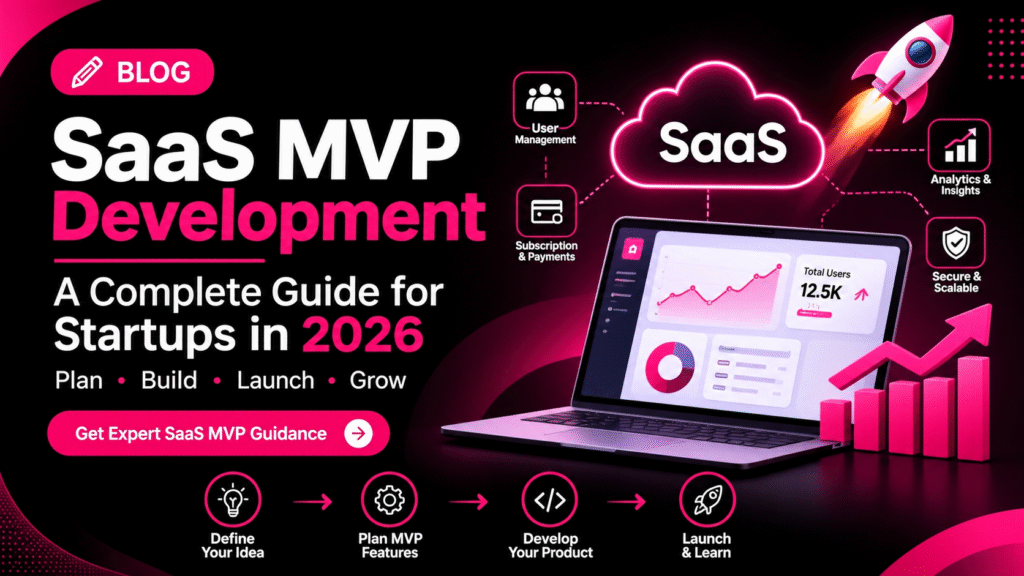
SaaS MVP Development: A Complete Guide for Startups and Businesses in 2026
Have an idea for a software product that customers can access through a monthly or yearly subscription?
You might be planning a project management tool, CRM platform, online booking system, AI-powered business application, or another subscription-based software product.
But before investing a large amount of money in building the complete platform, there is one important step: SaaS MVP development.
Many startups make the mistake of developing too many features before understanding what their customers actually need. This can increase development costs, delay product launches, and create unnecessary technical complexity.
A SaaS Minimum Viable Product (MVP) helps you launch a focused version of your software with essential features, test it with real customers, collect feedback, and validate your business model.
In this guide, we explain what SaaS MVP development is, how to build a SaaS MVP, which features to include, how much it may cost, and how to choose the right SaaS development company in India.
What Is SaaS MVP Development?
SaaS MVP development is the process of building the first usable version of a Software as a Service (SaaS) product with only the essential features required to solve a specific customer problem.
SaaS applications are generally accessed through the internet, allowing customers to use software without installing and maintaining the entire application on their own systems.
Examples of SaaS products include:
- Customer relationship management software
- Project management platforms
- Accounting and invoicing applications
- HR and employee management systems
- Marketing automation platforms
- Online appointment booking software
- AI-powered business tools
- Inventory management systems
Instead of developing a complete software platform immediately, businesses can start with an MVP that focuses on the main functionality.
For example, if you want to build a CRM platform, your first version may include customer management, contact records, lead tracking, and a basic dashboard.
Advanced reporting, AI-based lead scoring, automated workflows, and additional integrations can be introduced later.
The objective is simple: build the essential product, validate customer demand, and improve it based on real-world feedback.
Why Should Startups Build a SaaS MVP Before Developing a Full Product?
Launching a SaaS product involves more than writing software. You need to understand your customers, validate your business model, and determine whether people are willing to pay for your solution.
Here are the major benefits of SaaS MVP development.
1. Validate Your SaaS Business Idea
A business idea may sound promising, but actual customer demand needs to be tested.
A SaaS MVP allows you to introduce your product to early users and understand whether it solves a genuine problem.
You can collect feedback, observe usage patterns, and identify the features customers value most.
2. Reduce Initial Development Investment
Developing a complete SaaS platform can require significant time and resources.
By focusing on essential features, startups can avoid spending their initial budget on functionality that may not be necessary.
3. Launch Your SaaS Product Faster
A smaller development scope allows your team to concentrate on the core functionality.
This can help you introduce your product earlier and begin learning from actual users.
4. Understand Your Target Customers
Early users can help you understand:
- Which features they use most
- Where they experience difficulties
- What problems remain unsolved
- Which improvements they expect
- Whether they find the product valuable
This information can guide future product development.
5. Build a Foundation for Future Growth
A properly planned SaaS MVP can become the foundation of a larger software platform.
As your customer base grows, you can introduce additional features, integrations, subscription plans, and automation.
Essential Features to Include in a SaaS MVP
One of the most important decisions in SaaS MVP development is selecting the right features for the first release.
Your initial product should provide enough functionality to solve its primary customer problem.
Here are some commonly required SaaS MVP features.
1. User Registration and Login
Users should be able to create accounts, log in securely, and manage their profiles.
Depending on the product, you may also need email verification, password recovery, and role-based access.
2. User Dashboard
A dashboard provides users with an overview of their account, activities, and important information.
For example, a CRM dashboard may display leads, customer records, pending tasks, and recent activities.
3. Core Product Functionality
This is the most important part of your SaaS MVP.
Your application must perform the primary task that customers are paying to solve.
Examples include:
- Lead management in CRM software
- Task management in project management tools
- Invoice generation in accounting software
- Appointment management in booking platforms
- Campaign tracking in marketing software
4. Subscription and Payment Management
If your SaaS product follows a paid subscription model, you may need:
- Subscription plans
- Payment gateway integration
- Billing management
- Subscription status
- Payment history
- Upgrade and cancellation workflows
For a private beta, you may initially validate demand with manual subscriptions or limited access before implementing a complete billing system.
5. Admin Dashboard
An admin dashboard helps the business owner manage the software platform.
Common functionality includes:
- User management
- Account management
- Subscription monitoring
- Content management
- Usage monitoring
- Basic reporting
6. Notifications and Communication
Notifications help users stay informed about important activities.
Depending on your product, these may include email notifications, in-app alerts, or reminders.
7. Data Management and Security
A SaaS platform must manage user data appropriately.
Important considerations include authentication, access permissions, secure data storage, backups, and suitable privacy controls.
Not every SaaS MVP needs every feature listed above. Select features according to your business model and target customers.
How to Build a SaaS MVP: Step-by-Step Development Process
Building a SaaS product requires a structured approach. A clear development process helps manage requirements, control scope, and avoid unnecessary expenses.
Step 1: Identify the Problem Your SaaS Product Solves
Start by understanding the problem you want to solve.
Ask yourself:
- Who experiences this problem?
- How are customers solving it currently?
- What limitations do existing solutions have?
- Why would customers choose your product?
- What is the main benefit your SaaS application provides?
For example, if you are building employee management software, your initial product may focus on simplifying employee records and leave management.
A clear problem statement provides direction for the entire project.
Step 2: Define Your Target Audience
Identify the first group of customers you want to serve.
Your target audience could include startups, small businesses, enterprises, agencies, freelancers, or a specific industry.
Understanding your customers helps you prioritise relevant functionality and design a better user experience.
Step 3: Define Your SaaS MVP Scope
List all the features you have planned for your software.
Then divide them into three categories:
Must-have: Essential functionality required for the first release.
Should-have: Useful features that can improve the product but are not immediately necessary.
Future features: Advanced functionality that can be introduced after validating the product.
For example, a basic CRM MVP may include:
| Feature | Priority |
|---|---|
| User registration | Must-have |
| Contact management | Must-have |
| Lead management | Must-have |
| Basic dashboard | Must-have |
| Task reminders | Should-have |
| Advanced analytics | Future |
| AI lead scoring | Future |
| Advanced automation | Future |
This prevents unnecessary feature expansion during the first development phase.
Step 4: Plan UI/UX Design
Your SaaS application should be easy to understand and use.
The design stage may include:
- User journey mapping
- Wireframes
- Dashboard design
- Navigation structure
- Responsive layouts
- Interactive prototypes
Focus on making the most important workflows simple.
Step 5: Choose the Right Technology Stack
Your technology stack influences how your SaaS application is developed, maintained, and expanded.
Depending on your requirements, your development team may evaluate:
- Frontend technologies such as React or similar frameworks
- Backend technologies such as Node.js or other suitable server-side frameworks
- Databases such as PostgreSQL or MongoDB
- Cloud infrastructure
- Authentication services
- Payment gateway integrations
- Analytics and monitoring tools
The right technology depends on the application’s functionality, team expertise, integration requirements, and long-term product plans.
Step 6: Develop the Frontend and Backend
The frontend is the part customers interact with, including dashboards, forms, navigation, and application screens.
The backend manages application logic, databases, authentication, APIs, and communication between different components.
Both components must work together to provide a reliable user experience.
Step 7: Test Your SaaS MVP
Before launching, test the application thoroughly.
Testing may include:
- Functional testing
- User interface testing
- API testing
- Authentication testing
- Compatibility testing
- Performance testing
- Security testing
Testing helps identify problems before customers begin using the product.
Step 8: Launch and Collect Customer Feedback
Once the essential features are ready and tested, launch your SaaS MVP to an initial group of users.
Monitor customer feedback, feature usage, user engagement, and technical issues.
Use this information to decide what should be improved or developed next.
SaaS MVP Development Cost in India in 2026
One of the most common questions startup founders ask is: How much does SaaS MVP development cost in India?
The cost depends on the application’s complexity, features, design, technology stack, integrations, and development requirements.
The following figures are indicative planning estimates.
| SaaS application type | Estimated development cost |
|---|---|
| Basic SaaS MVP | ₹2 lakh – ₹4 lakh |
| Standard SaaS MVP | ₹4 lakh – ₹8 lakh |
| Advanced SaaS MVP | ₹8 lakh – ₹15 lakh |
| Complex SaaS platform | ₹15 lakh – ₹25 lakh+ |
| AI-powered SaaS MVP | ₹4 lakh – ₹15 lakh+ |
These are illustrative ranges, not fixed quotations. Actual project costs depend on the scope, number of user roles, subscription workflows, security requirements, integrations, and infrastructure.
What Factors Affect SaaS Development Cost?
1. Application complexity: A simple business tool requires different development effort from a multi-user SaaS platform with complex workflows.
2. Number of features: More features require additional design, programming, and testing.
3. UI/UX design: Custom dashboards and advanced user experiences may increase design effort.
4. Backend architecture: Database design, user permissions, APIs, and business logic influence development complexity.
5. Subscription management: Billing, recurring payments, plan upgrades, and cancellation workflows add development requirements.
6. Third-party integrations: External APIs and services may involve additional development and recurring usage charges.
7. Security requirements: Applications handling sensitive information may require additional security controls and compliance work.
How Long Does It Take to Build a SaaS MVP?
The timeline depends on the number of features, application complexity, design requirements, and integrations.
A focused SaaS MVP may take approximately 6–12 weeks, while more complex products may require additional time.
A typical development plan may look like this:
| Development stage | Estimated timeline |
|---|---|
| Requirement analysis | 1 week |
| MVP scope and planning | 1 week |
| UI/UX design | 1–2 weeks |
| Frontend development | 2–4 weeks |
| Backend development | 2–4 weeks |
| Testing and quality assurance | 1–2 weeks |
| Deployment | Around 1 week |
Some stages can happen simultaneously. Your actual delivery schedule should be agreed with the development team based on the final scope.
Common SaaS MVP Development Mistakes to Avoid
Even a promising SaaS idea can face problems if the first version is not planned properly.
Avoid these common mistakes.
1. Building Too Many Features
Trying to include every possible feature can increase development costs and delay your launch.
Start with the functionality that solves your customers’ main problem.
2. Ignoring Customer Research
Do not assume that customers will use every feature you develop.
Speak to potential users and understand their actual requirements.
3. Choosing Technology Without Planning
Selecting a framework simply because it is popular may not be appropriate for your product.
Evaluate your application requirements before choosing the technology stack.
4. Ignoring Subscription Management
If your business model depends on recurring revenue, plan how customers will subscribe, pay, upgrade, and cancel.
5. Neglecting Security
Authentication, data access, backups, and privacy should be considered from the beginning.
6. Skipping Testing
Launching without sufficient testing can damage user confidence and create avoidable technical problems.
7. Not Planning Post-Launch Improvements
Your first release is the beginning of product development, not the end.
Create a process to collect feedback, monitor usage, and prioritise improvements.
How to Choose the Best SaaS MVP Development Company in India
Choosing the right SaaS development company can influence your product’s quality, launch timeline, and future development.
Before hiring a development partner, consider the following:
Relevant experience: Review previous experience in SaaS application development, web applications, and custom software.
Technical expertise: Check whether the team understands frontend, backend, databases, APIs, and cloud infrastructure.
Transparent pricing: Ask for a detailed quotation that clearly explains the development scope and deliverables.
MVP planning: Choose a team that helps prioritise essential features instead of recommending unnecessary functionality.
Communication: Confirm how progress, revisions, feedback, and milestones will be managed.
Source code ownership: Clarify ownership of source code, credentials, design files, and documentation.
Post-launch support: Understand the maintenance arrangements, bug-fixing process, and future development costs.
The right development partner should help you make practical decisions about both your first release and your future product roadmap.
Why Choose Crawlers Technologies for SaaS MVP Development?
At Crawlers Technologies, we help startups and businesses transform software ideas into practical digital products through custom application and software development.
We focus on understanding your business requirements, identifying essential features, and planning a development approach that supports your product goals.
Our development services include:
- Custom SaaS application development
- Web application development
- Custom software development
- Android and iOS application development
- Business management applications
- CRM and workflow applications
- E-commerce application development
- Marketplace development
- AI-powered application development
Whether you are planning your first SaaS startup or developing a new software platform for an established business, our team can help you plan and develop a solution aligned with your requirements.
Our approach focuses on building useful functionality, providing a clear development process, and creating a foundation for future improvements.
Frequently Asked Questions About SaaS MVP Development
1. What is a SaaS MVP?
A SaaS MVP is the first usable version of a subscription-based software product. It contains essential features that help solve a specific customer problem and validate market demand.
2. How much does SaaS MVP development cost in India?
A basic SaaS MVP may cost approximately ₹2 lakh to ₹4 lakh, while more advanced products can cost ₹8 lakh to ₹15 lakh or more. The actual cost depends on features, complexity, technology, and integrations.
3. How long does it take to build a SaaS MVP?
A focused SaaS MVP may take approximately 6–12 weeks. More complex products may require additional development time.
4. What features should a SaaS MVP include?
Common features include user registration, authentication, a dashboard, core product functionality, data management, admin controls, and subscription management where required.
5. Can I build a SaaS MVP with a limited budget?
Yes. Start by identifying your core customer problem and developing only the essential features. You can introduce advanced functionality after validating the product.
6. What is the difference between SaaS MVP and a full SaaS product?
A SaaS MVP focuses on essential functionality needed to validate the product. A full SaaS product may include advanced features, automation, analytics, integrations, and expanded user management.
7. Which technology is best for SaaS development?
There is no single best technology for every SaaS application. The right choice depends on application complexity, team expertise, security requirements, integrations, and future product plans.
8. Can I add more features after launching my SaaS MVP?
Yes. A properly planned SaaS MVP can be improved with additional features, subscription plans, integrations, automation, and performance enhancements.
9. Do SaaS applications require ongoing maintenance?
Yes. SaaS applications typically need software updates, security improvements, infrastructure monitoring, bug fixes, and database maintenance.
10. How do I choose a SaaS MVP development company?
Evaluate the company’s relevant experience, technical expertise, development process, pricing transparency, source code ownership, communication, and post-launch support.
Ready to Build Your SaaS Product? Let’s Get Started!
Have a SaaS idea but don’t know how to turn it into a working product?
You don’t need to build an entire software platform from day one. Start with the essential features, validate your idea, and improve your product as your business grows.
At Crawlers Technologies, we help startups and businesses plan and develop custom SaaS applications, web applications, mobile apps, and business software.
Let’s discuss your idea, identify the right MVP features, and plan a development approach that fits your business requirements.
GET YOUR FREE SAAS MVP CONSULTATION
Crawlers Technologies
Website: https://crawlerstechnologies.com/
Contact: +91 97387 38578
Start with an idea. Build your SaaS MVP. Grow your business.