Building a mobile app can be a great investment for businesses looking to expand digitally. However, many companies focus only on the initial development price and overlook several hidden costs that can significantly impact the overall budget.
Understanding these hidden expenses before starting your app development project can help you plan better and avoid unexpected surprises.
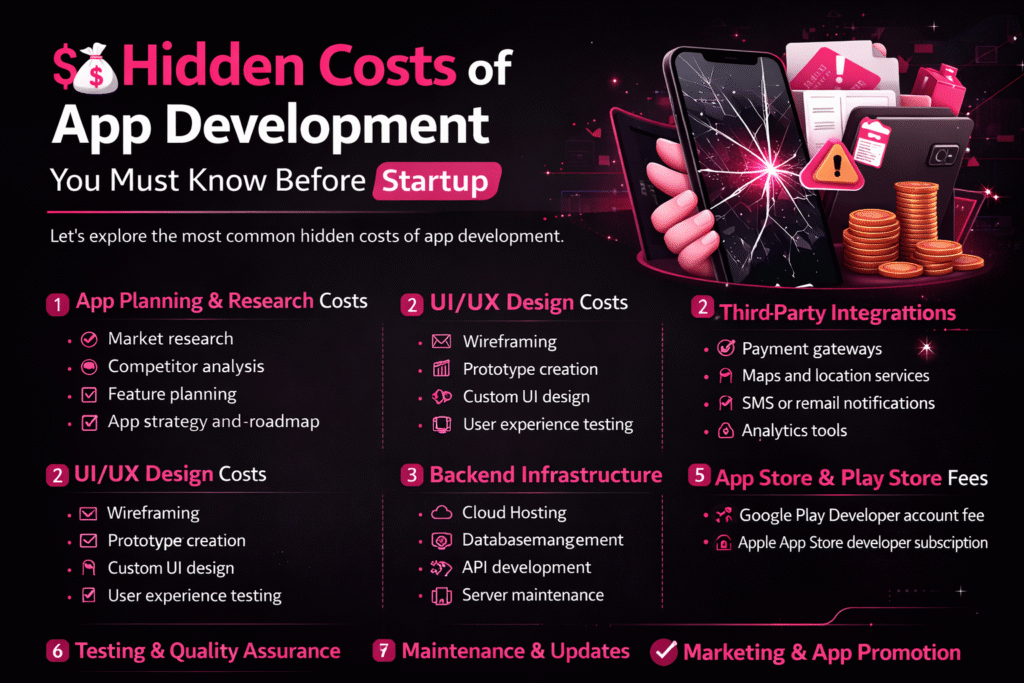
Let’s explore the most common hidden costs of app development.
🧠 1. App Planning & Research Costs
Before development begins, proper planning is essential. Many businesses skip this step or underestimate its importance.
Planning includes:
-
Market research
-
Competitor analysis
-
Feature planning
-
App strategy and roadmap
Without proper planning, projects often face delays, redesigns, and additional development costs.
🎨 2. UI/UX Design Costs
A great user interface and smooth user experience are critical for app success.
Design costs may include:
-
Wireframing
-
Prototype creation
-
Custom UI design
-
User experience testing
Businesses that ignore professional UI/UX design often end up spending more later fixing usability issues.
🔐 3. Backend Infrastructure
Many apps require backend systems to manage data, users, and communication between servers and the app.
Backend costs include:
-
Cloud hosting
-
Database management
-
API development
-
Server maintenance
These ongoing expenses are often not considered during initial budgeting.
💳 4. Third-Party Integrations
Modern apps frequently integrate with external services such as:
-
Payment gateways
-
Maps and location services
-
SMS or email notifications
-
Analytics tools
-
Social media login systems
Most of these services charge subscription or usage fees, which add to the long-term cost.
📱 5. App Store & Play Store Fees
To publish your app on app stores, you must pay registration fees.
Typical costs include:
These fees are relatively small but still necessary for launching the app.
🧪 6. Testing & Quality Assurance
Proper testing ensures that your app works smoothly across different devices and operating systems.
Testing costs include:
-
Manual testing
-
Automated testing tools
-
Performance testing
-
Security testing
Skipping testing may lead to bugs that damage user experience and reputation.
🔄 7. Maintenance & Updates
App development doesn’t end after launch.
Ongoing maintenance includes:
Maintenance usually costs 15–20% of the original development cost per year.
📢 8. Marketing & App Promotion
Many businesses forget to budget for marketing.
Even the best app needs promotion to attract users.
Marketing expenses may include:
Without marketing, your app may struggle to gain visibility.
⚡ 9. Scalability & Performance Upgrades
As your user base grows, your app infrastructure must scale.
Additional costs may arise for:
-
Higher server capacity
-
Performance optimization
-
Security improvements
-
Database upgrades
Planning for scalability helps avoid technical problems in the future.
💡 Final Thoughts
App development involves more than just coding. From planning to marketing and ongoing maintenance, several hidden costs can influence your overall investment.
By understanding these costs in advance, businesses can create a realistic budget and avoid unexpected financial challenges.
A well-planned app development strategy ensures your project runs smoothly and delivers long-term value for your business.